Saturday, February 23, 2013

joist tables

Well, getting closer to pole barn time. We'll selected the contractor, have had the dirt mover come out to measure the site for his quote, so now I turn toward figuring out the workshop I plan to build myself. this will be a 20' x 32' section of the barn. With 14' eave height, I plan to make an 8' ceiling, and use the space between the ceiling and the lower truss chords as storage. Meaning- the ceiling is actually a floor, and needs to hold some amount of weight. I've never designed in wood before, so am learning about joist tables. I had never thought about choosing live loads or figuring out what the density of hay is, but need to make sure I get this right. I also want to try to avoid columns in the workroom so we are talking 20; spans. I am now learning about LVL- laminated veneer lumber. It's more expensive per board foot, but stronger, so I will be doing some comparison shopping. Pole barn is scheduled for mid June, so I'll do the workshop in late June. We are figuring we will probably do the bike trip with Joe in July, so the summer is filling in rapidly.

Here is a photo from this winter, me doing my first field dressing.

Sunday, January 6, 2013

HDPE

high density polyethylene is the plastic of choice for so many things. The drought in our area does not at this time look like it is going to end, as there has not been that much snow or train to adequately rehydrate the soil. So....., am getting ready to invest in a water storage tank, to be used to drip irrigate our trees. We almost bought the setup last summer, but I don't want to loose any more trees, and we will want the tank anyway, for when the pole barn is built and we collect rainwater from the roof. Figuring out the drip tape and a wagon to haul the tank will be next. Several sources for the tanks, even Nelson's had some selection last summer. I may stop in next trip and see what they have, and if I can order one.

Tuesday, December 11, 2012

rotten apples

Here are some hedge apples, being left out for the winter to rot. I got some from brother Tom and some from sister in law Brenda. The plan is to start experimenting with living fencing. I've read a bit about Osage Orange, aka hedge apple, and its history as a windbreak and hedge, but don't know how well it will do this far north. If it works out, the periodic pruning and coppicing will provide excellent firewood, as it has by far the highest heating btu content of trees in North America. You are supposed to let them decompose through the winter, then turn them into a souply mess, and dribble the seeds into a furrow in the spring, thinning as required after they get started. The technique requires close planting, and severe pruning to keep them from getting out of hand and to encourage lower level branch growth. You can then get as fancy as you like, bending over and weaving, and even laying hedge like in England, but I don't know how far down that road I'll go. The other experiment will be Hawthorne. I'm finding it harder to get "free" starts, so may go slower with that stretch till I find a good source. Just fencing the 25 acre field will require about a quarter mile of fence, depending on how much I want to enclose, so this is a long term project.


Of course the other rotten apples are the ones from our apple tree that never did sweeten up, even after frost. They looked good on the tree, but did not taste good. After a hard freeze, they turned brown and softened up, so they will be deer food. Gotta make a cider press. The backlog for my yet to be built workshop is getting longer.....

Wednesday, October 24, 2012

choose wisely

Indiana Jones and the Last Crusade- The ancient knight says "you must choose, but choose wisely".

So, it always helps if someone else goes first, right? Make note of others mistakes and DO NOT repeat them. The next memorable quote from the movie "he chose..... poorly". Indy then gets one of those under pressure leaps of insight that only happen in movies, and picks the right goblet. Would that life were like that more often. We make mistakes our whole lives, some big, some small, some are of the game over variety. Because of the upcoming discontinuity I think might happen, this is not time to copy what others are doing, and just go along without thinking 20 years out.

So in my preparations to get a permaculture farm up and running, I have been talking to our local permaculture expert and serious hands on practitioner, and reading books. Some books will be useful reference to keep on the shelf, but some will give me reason to alter current plans and deepen my understanding of the system aspects that must be accounted for.

The excellent advise and shared wisdom I am gathering right now is from the book by Harvey Ussery "The Small Scale Poultry Flock". I recommend it ( for what that is worth, this blog is more of a diary than anything) for anyone with the room and inclination to raise chickens. The book is both filling in the detail of what I only had a general notion of, as well as making me realize I have even more work to do than I thought to create a productive efficient biosystem on our farm.

Saturday, October 13, 2012

the apple cycles

Last year, we got quite quite a few apples, and still have some canned apple sauce from them. This year not so much. I think everyone knows that the spring was weird, with an abnormal early warmth, followed with a late hard frost. This hurt fruit trees to varying degrees in the midwest, and then we had a very dry summer. These seem like the most obvious variables that would cause yield to bounce up and down from year to year, but I imagine there are others I don't recognize yet.

We had very few apples on several of the trees this year, but one had a middling yield, but had a lot of the disease shown above. I still know practically nothing about trees yet, so don't know what it is. Adding to the oddness, one tree, off by itself around 50 yards from the others, is absolutely loaded, and no sign of any disease or insect damage. We will probably harvest this next weekend. The apples are rather small, probably more because they should have been thinned some.

I hope to be better prepared to do a decent thinning job next spring. (After some hard pruning this winter, these trees had no attention for years).

It seemed like out tomatoes took forever to start ripening, but we ended up with an ok yield. We had to pick the last of them while green, since we wouldn't be back up before the likely first frost. Here is what they look like as they slowly ripen. Every couple days, we process a small batch, and as of today, they are almost all done.

Thursday, October 4, 2012

pole barns

We need a building. We need under roof storage, so the garage can resume its normal function, we plan to do livestock, and I need a workshop area. Hence a barn. Since we don't live there yet, and a pole barn is a big project, we will use a local contractor to build it for us next summer.

So now I'm learning that pole barns ( or pole sheds, as many insist on calling them. I guess in my size range, maybe "barn" is a tad presumptuous. ) are apparently such a standard and well known commodity, that everyone just assumes we know all the details involved. I really have avoided revealing I'm an engineer, but rather trot out the yuppie from the suburbs schtik to explain my ignorance. To inquire about the design basis, or how they determine the truss size or spacing evokes hesitation and a slightly embarrassed perplexity as to how to answer.

I am doing parallel study in the internet, but haven't dug too much yet. I know that many details and standard methods are driven by building codes and years of knowledge passed down, and are fine if done to code, but how do I know whether an individual guy is making it up or is cutting corners? One more reason I'm getting three quotes.

And one of the contractors is Amish, which brings a whole new layer of communication difficulty. I drove out to his house twice just to initiate discussions. He will be mailing me his quote in the next few days. I was fortunate that he is one of the Amish who uses phones, though I believe the phone is in a little shed outside the house. Turns out that because of where we live, he figures he will use the horses to come to work. Beyond a certain radius, he hires a "English" driver to haul him, his crew and tools to out place.

We also have had a heck of a time choosing a flat, accessible location. As it is, we'll be doing some dirt work and recontouring part of the pasture. The issue with getting a building permit deserves a whole other post.

Saturday, September 22, 2012

saw buck

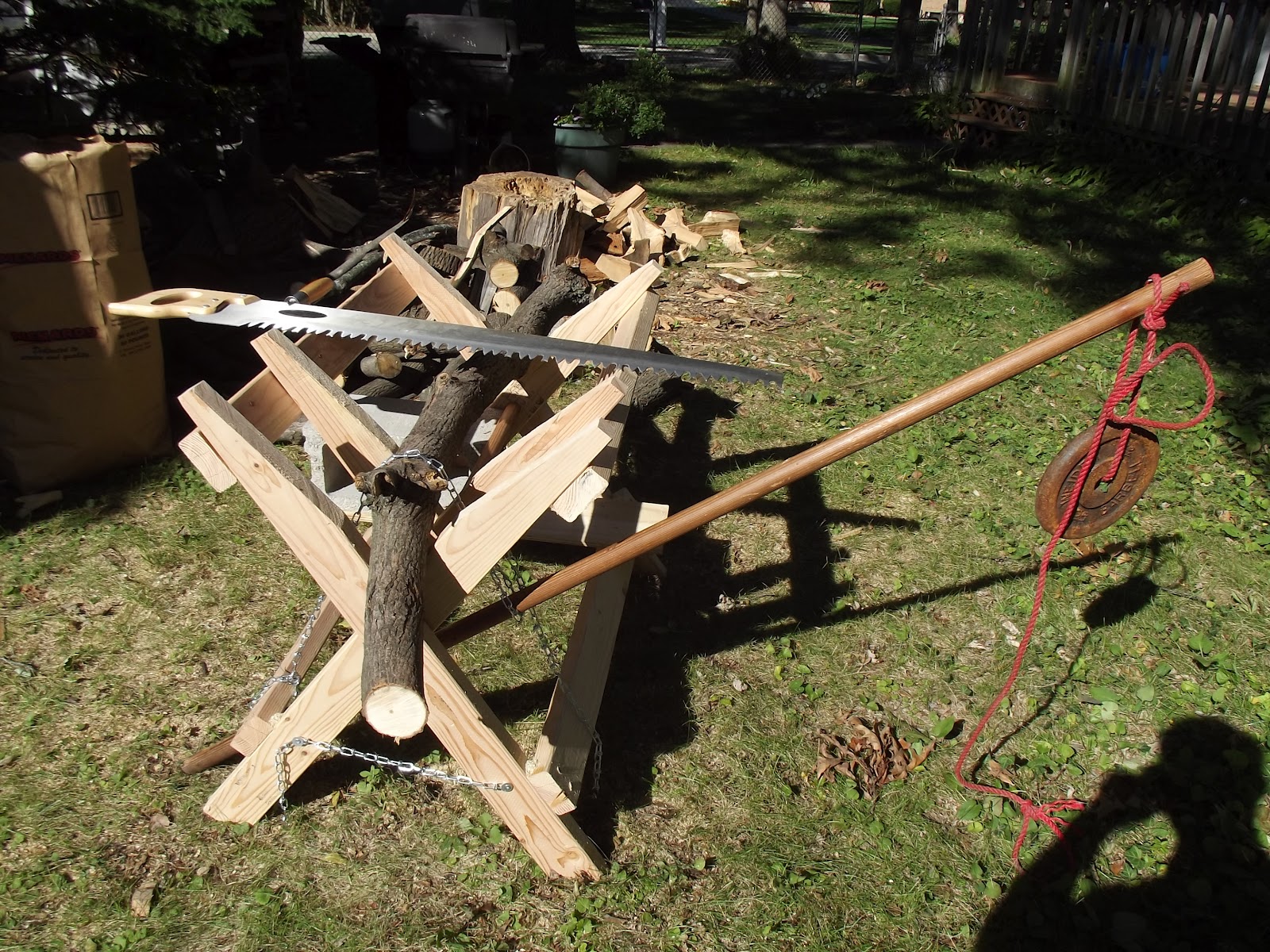
Here is the sawbuck. I'm getting the hang of the best saw stroke, but still need to come up with a good way to quickly grip the wood during cut, then release for the next piece. Current setup works, but is a kludge. This is all large branches left from the wind downed trees in July. It's soft maple, so easy to cut.


Here is a bonus photo of our earlier garlic harvest. With the heat and drought, garlic finished early, but the size was good and we had a pretty good crop. It's all cured and stowed away now. We'll actually be planting from some of these bulbs soon, probably our trip in late October.