Monday, February 7, 2022

Seeing the water


Don't know how much truth there is to it, or if the truth of it really matters, but there is a saying that fish aren't aware of the water they live in because they are immersed in it from birth, and it is just a universal aspect of every part of their lives.


The concept is then used for us to imagine what aspect of our lives is unquestioned and "invisible" to us because it's always there and is background to us, even though it is essential or has major impact on our behavior.

So, weak as the analogy is, what things are there that we "swim through" every day that we need to realize affect us? How could one stand to the side, summon up an impartial perspective, and see the paradigms we live by that might be completely arbitrary or even dysfunctional?

We are more complex than fish ( in some ways) so there could be myriad layers of reality and human interaction that are taken for granted but might be available for understanding and acknowledgment. 

White privilege is a concept recently in the news that is a good example of one of these layers that at least the Caucasian of us in the U.S. could try to gain awareness of. That particular layer is not a universal, but are there other, more universal media that all human societies are immersed in? If not, what does that say? If so, what are they?

I think one of, if not the most important invisible mediums we are immersed in is that of the luxury and ease afforded by our fossil fuel slaves. A barrel of oil contains the equivalent of roughly 25,000 hours of human labor. Here is a good primer on the concept:

http://22billionenergyslaves.blogspot.com/2013/11/our-army-of-invisible-helpers.htm

Every waking minute, we ( at least those of us likely to be reading this blog on our electronic devices) are surrounded by materials, services, and ease of life entirely supported on a foundation of fossil fuels. To become aware, and appreciate the implications, one soon thinks about the ephemeral state of this ease that relies on a resource that is soon to decline. Ask yourself, what should a fish do when it senses the waters receding? Maybe swim toward waters from another source?

I've been reading books lately about the widely varied ways that humans have gone about organizing themselves in groups, cultures, empires, and what it might mean for our potential to chart a rational future path. 

I gotta say, there have been ( and are) some really weird beliefs and ways humans have chosen to organize themselves.

But we first worlders of usually European descent currently seem to all think that all that history inevitably led up to us, as we are, and things will just keep on progressing......Where?

We are in a time of change, and it will require massive acts of imagination and reflection to see the myriad waters we swim in, and figure out the direction toward water from deep, reliable springs.



Sunday, January 23, 2022

seeds of change

 I just received the last of the garden seeds I ordered. Last year, covid caused a lot of first time gardeners, and seed availability was affected. I had to scramble to get everything on our list, but ended up ok, just couldn't get some of our favorite varieties.

This year I ordered a bit early, and did see a bit of sold out stock, but in general, much better than last year. So, did all those new gardeners become once off gardeners? Did the seed companies ramp up in reaction to the new surge? Don't know, but we are set, and starting plants indoors is not that far away.

I have never listed what all we grow, but thought I would now just to show the large variety, which we feel is important to stay resilient, since the weather from year to year results in some veggies having a good year, and others a dud. This way we always have something to put in the larder. We are also shifting further to heirlooms and less hybrids, to do more seed saving than we have so far.

So here you go, in no order, just off the top of my head.

carrots

parsnips

beets

broccoli

brussels sprouts

lacinato kale

collards

lettuce

red cabbage

green cabbage

shelling peas

potatoes

flint corn

four types of soup beans

butternut squash

honey nut squash

kabocha squash

cucumbers

red onions

yellow onions

shallots

hard neck garlic

ancho peppers

sweet peppers

cherry tomatoes

slicer/sauce tomatoes

zucchini

lima beans

rutabaga

swiss chard

okra

So that's the garden. We have an asparagus and rhubarb patch, and some black raspberries that are going a bit feral.

We also grow cilantro, basil, rosemary, thyme, and mint in our herb garden near the house.

In past years, we've grown wheat, green beans and sweet corn, but we still have plenty of wheat and green beans ( both canned and frozen), and corn can be a pain, takes a lot of room, so now just buy from a local farm that specializes in it.

I also ordered some more trees. More apple, pear, tart cherry, hazelnuts, and some hackberry for the critters. I'll review the trees in more detail another time.

Here is the south garden, asleep in the snow. 9F ( -13C) as I type.


Monday, September 13, 2021

September

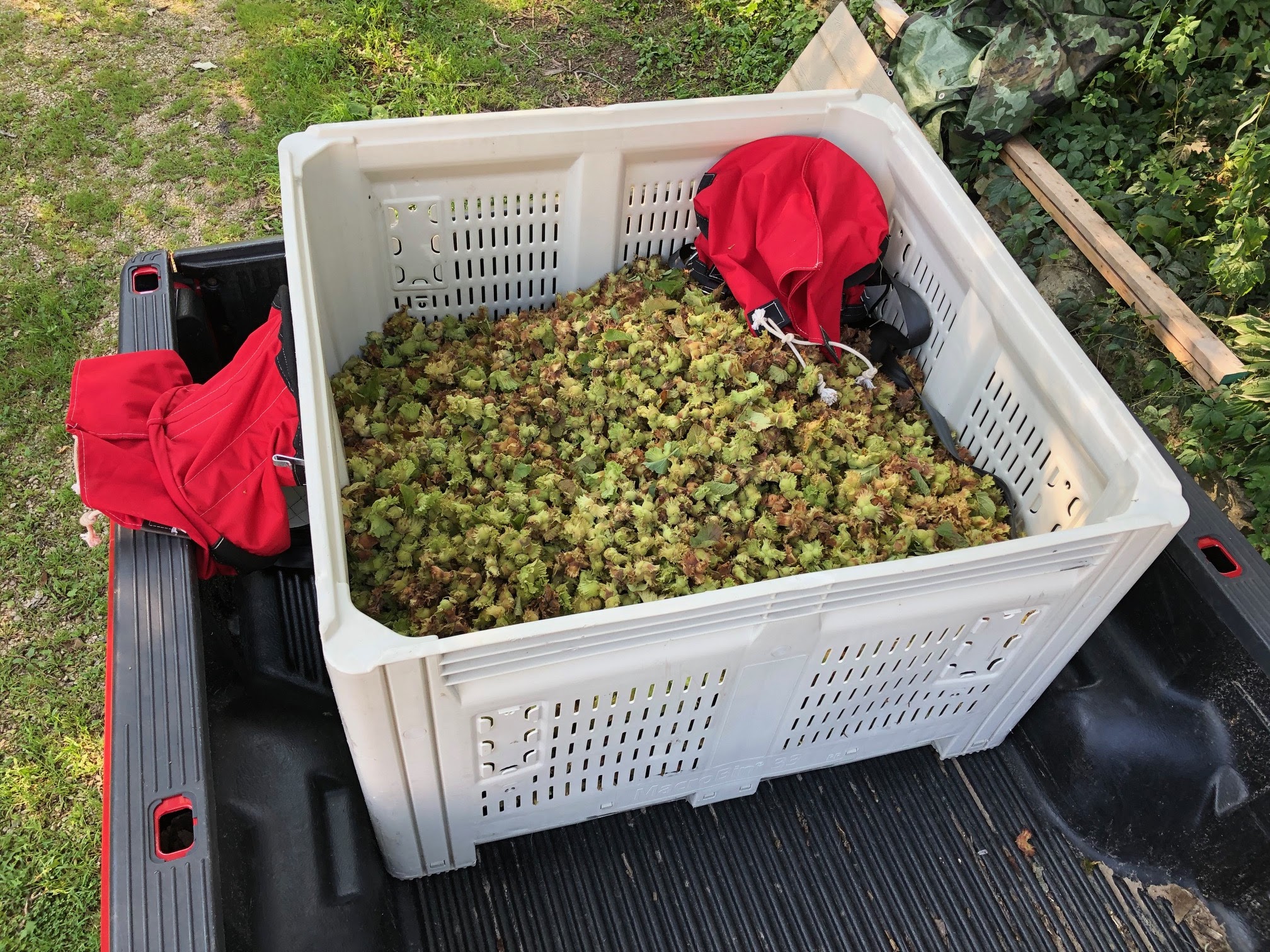
 Wow, time has flown this summer. I won't try to recap, but for now will just mention that we finished harvesting this year's hazelnuts.

Our hazelnuts are hybrids, and some plants have bushlike genetics, and some have more treelike genetics, and they all ripen at different times, and have different sized nuts. As the outer husk, or involucre starts drying and separating from the nut, you only have a short amount of time to pick the nuts directly from the bush. Once the nuts fall to the ground, collection is very tedious, and probably a net loss of calories.

So once "most" of the nuts are ripe enough, we pick them all, and let them finish drying in bins in the barn. Once they have finished drying, dehusking is much easier. They can then be stored for shelling later.

Each year, as the plants come more in to full growth and production, the yield has increased where it is real work to get them all picked before they fully dry and fall to the ground. Most will be sold, or traded as barter, but I'm saving back a good portion to eat and experiment with various recipes.

I'm bad at photographing progress, but here in the back of the truck is one of the harvest bins half full. We eventually harvested about three binfulls of nuts.


Friday, May 28, 2021

finger pointing

https://slate.com/technology/2021/05/shell-dutch-court-ruling-engine-no-1-exxonmobile.html

This article is just one of many I could have linked that describe the litigation, protest, and anger aimed at fossil fuel companies. The number of people around the world that are becoming aware of and concerned about global warming grows continuously, but full awareness is sadly lagging.

Oil companies would collapse into bankruptcy if there was no demand for their products. We the consumers are the other partner in this dead end pillage and waste of the planet's resources. Until we acknowledge our own complicity and truly make the changes needed, this era will continue ineffective and misguided confrontation theater.


I fully realize that the changes required are massive and painful, but we live on a finite planet. It's not an if, but a when the party will end. It would be preferable to wind down in an organized, methodical fashion than through chaos.  And I admit how far I have to go to change. All I can do is work on it one step at a time, and not waste time looking for scapegoats.

And while I'm at it, can we all quit fixating on climate change? It's a terrible thing we've wrought, but it's a SYMPTOM. I think I understand why the environmental movement decided to focus on climate change, but now wonder if it was a strategic mistake? There was probably no good way to tell people they have to scale back and live a much less convenient life.

The real issue is overconsumption, and climate is one of the many side effects of our population overshoot and lifestyles. If we somehow figured out how to reduce CO2 in the atmosphere from some Deus ex machina technology, we'd still be screwed by all the other impacts and depletion that are unwinding at the same time.


Won't be that long till they all look like this. What then?


Oil companies have been defensive and even deceitful, but they are protecting their interest as we all have been doing by denying our part in this.  So stop blaming oil companies and look inward.

Ok, end of rant. (too much coffee).


Tuesday, May 18, 2021

Gardening Sheds on fire

 I have been slowly gathering materials for a garden shed.( turns out TOO slowly! material prices have gone nuts due to pandemic caused disruptions in supply and demand)

Design decisions have prioritized local materials, and attempts to be more sustainable. A nearby friend has his own sawmill, making lumber from pines that were on his land. I bought most of the framing lumber I needed from him.

The roof will be steel, bought from a local Amish business. The steel coils aren't actually made there, but they fabricate the roofing panels there. All without electricity.

Here is the real experiment though, something I had never heard of till recently, and why I titled the post like I did.

There is a technique of siding preservation that involves charring the surface. This layer of charred wood minimizes rot and sun weathering, since fungus cannot break down this form of carbon, and leads to very long lifetimes for the wood. 

This technique is becoming all the rage recently, and was first widely used in Japan. Thus it's name(s).

https://en.wikipedia.org/wiki/Yakisugi

https://mrtimbers.com/shou-sugi-ban/


Will post later on  how it goes.


Monday, March 29, 2021

storing eggs long term

 We've been keeping a flock of laying hens for a few years now, and are used to the annual up and down cycle of egg production. In late fall, as molting happens, and as hours of daylight lessen, we get fewer eggs. And since some of the hens are getting on in years, the falloff can be rather dramatic. 

Today, late March, they are back in good production, and laying more eggs than the two of us can eat. In the past, we would sell or barter some, but that has been more random this year, so I started thinking about ways to store and even out our egg supply through the year. 

I remember reading about pioneers heading out across the plains with eggs in barrels full of lard or waterglass ( sodium silicate), but both those ideas sounded rather messy and uncertain.

I searched various homesteading and prepping websites, and settled on using pickling lime ( calcium hydroxide) solution. Eggs need to be unwashed and fresh from the hens, and clean. The source I used says use a ratio of an ounce of pickling lime to a quart of water, and make sure eggs are fully submerged.

I have no idea by what mechanism this is supposed to work, so this is definitely an experiment.

While the solubility in water is not that great, it does enough that the resulting solution has a pH of over 12. We will store away a few dozen now, and try them out next winter, to see how well this works. I'll do a post then to report how well the technique works.

Here is the solution right after mixing and pouring over the eggs:


And here is the solution after much has settled out:


Wednesday, February 24, 2021

descent engineering part two

Back in April of 2017, I posted some thoughts on what the engineering discipline should try to consider for design criteria as we approach the end of the fossil fuel era. What I did not do, was list any of the things that the engineering disciplines should first figure out how to redesign.

There is an uncertain amount of time till we get severe energy constraints on making infrastructure choices.  It would be best to work over those things that are most critical to reducing the shock to society as our lifestyles change. We actually always have constraints on what is feasible, the ever-present gap between wants and needs.

We will be entering a phase where the balance between effort and return will be a marked change from what we've done the last two hundred years or so. Instead of the enormous energy source of fossil fuels, we'll be back to muscle, wind, water for power, and easy to mine materials will have been already harvested. So one would REALLY need something badly to marshal the effort and resources to create or maintain infrastructure.

Just a wild guess here, but we will probably have a century or two where engineering will be relevant and a potential aid to soften the descent.

In fact, the very profession of engineering may eventually become obsolete. At some point, craftsmanship and being limited to simple infrastructure will result that we won't need calculus or stress analysis. The odd cathedral or bridge would be made from stone and wood, and maybe one or two engineers. It'a actually amazing to see some of the structures that were designed without the aid of calculus and engineering as we know it today.

I read this account of the large dome built in Florence, Italy, and recommend it for the story as well as the example of significant structures that did not need engineers as we understand them today. 

https://www.amazon.com/Brunelleschis-Dome-Renaissance-Reinvented-Architecture/dp/1620401932

This architect's blog entry has the short version in the first ten or so paragraphs:
http://fiveyearsproject.blogspot.com/2015/05/brunelleschis-dome.html


I'll point out that they did it without fossil fuels and modern equipment, but it took generations to do, in addition to the devout faith based persistence required to complete something of this magnitude. What might our descendants deem justified to build at this level of effort and duration? 

So here are a few design problems that might be called engineering problems.

1. redesign concrete. They say the first thing to do when you find yourself in a hole is to stop digging. Concrete as made today will only last from 25-100 years. It takes huge amounts of energy to produce, and all the millions of tons we have built with it so far will need to be replaced if we want to maintain  our current arrangements, and much of it its coming to the end of its life. Time to stop making things from concrete. ( and believe it or not, we are running out of sand!)
https://www.businessinsider.com/global-sand-shortage-could-cause-damaging-effects-2018-12

Maybe engineers need to come up with a design method that replaces concrete with stone, or other natural materials, and begins creating standard designs for all the critical infrastructure we feel needs to be maintained. Even if they can't be rebuilt now, the designs will be there, "shovel ready". One would hope that modern stress analysis could make these designs more efficient than similar structures from the past that were made of stone.

2. Water. Again, many impressive canal and irrigation systems were built in the past without fossil energy or engineers, but designing new canals and water distribution for the locations which now rely on pumped water would be a key need. Another side result is that some cities or areas will be assessed and come up short on low energy input water options, and should be abandoned. In addition to water distribution, low tech ways to assure germ free water will need to be reinstituted. No more chlorine injection or pumps and motorized clarifiers to treat incoming water. 

Changing weather patterns will make this tricky to predict, but also making water management all the more important.

3. transportation- add more canals, reopen old abandoned canals, and redesign roads. Roman roads lasted ( and some still last) hundreds of years, because they were built to last. Copying Roman designs won't work for the many places that get freeze thaw cycles, plus, we have much heavier loads than the horse traffic of Roman times, so coming up with designs that don't use concrete or asphalt, and will last centuries would be useful for the key routes that will justify such effort.

4. Energy- Biogas, pyrolysis gas, oils, various ways to make electricity or generate mechanical work from organic materials exist, but need more design work to become more efficient, and to scale up to an appropriate level. Work has been done to burn pyrolysis gas and oils in turbines, but turbines have been optimized for methane, other fossil fuels, and need redesign for bio materials. I'm thinking that steam power could persist for quite a long time, and direct mechanical wind energy conversion will return as well. These could both benefit from the engineering analysis that has been done to make them more durable and efficient than their ancestors.

5. It's more of a question of political will, but transportation in general, especially shipping trade goods will need a return to simpler, low energy methods. 

So much of current engineering knowledge is bound up in, and caters to the high energy, complex technology society we live in. Once one starts thinking about what could persist without the initial foundation of plentiful energy, the house of cards looks pretty shaky. It also makes much engineering expertise a bit irrelevant in a low energy future.