Sunday, October 23, 2016

fanning mills

Well, I just today did my first Craig's List purchase. My kids are embarrassed but accepting of my backward "technophobe" behavior, and I still haven't bought anything through ebay, but this item was too intriguing to pass up. 

I have been researching manual threshing, winnowing, and there are not a lot of recent or current developments available. There are one or two gems shared on youtube, and lots of klutzy half hearted gadgets, but no commercial options, or detailed plans. There are a few commercially available "desktop" electrically powered seed cleaners out there, but they are pretty expensive. Of course India and China are teaming with businesses that would appear to be cranking out small scale agricultural equipment, but how does one get more detail than a fuzzy image on the screen or find a local distributor?

So I bought a fanning mill. It is in fairly good shape, and I see what needs repair, and feel confident I can make the fixes.

We are currently growing dry beans for soups, and have been hand threshing, shelling and winnowing. We have the time, and it's not that bad to sit and shell pods for a while each evening, but as we begin to do more and more food preservation and start growing small grains, our time will need to become more efficient.

The one I bought was made by Johnson and Fields, a fairly prominent brand at the time. The model was named the "Racine". The history has been hard for me to track down so far, but apparently Racine Wisconsin was a hotbed for fanning mill manufacturers, so Racine almost became a generic term for this general style of mill. At one time, there were scores of fanning mill makers, and thousands were sold every year for about 40-60 years. 

The history of fanning mills here in the states is interesting for a few reasons. They were first invented in the late 1700's, and as the fertile midwest and great plains expansion happened in the 1800's, there were thousands of small farms needing more efficient ways to process small grains for seed and for market. Going from flails and winnowing baskets to fanning mills was a big step, but once steam powered threshers started coming into agriculture, these fanning mills got tucked away in the barn, or left outside, nearly all to eventually rot and disappear. Seed cleaning is now nearly all done by commercial grain elevators, but there are still a few farmers out there, especially in the upper midwest grain belt that clean seed using electrical powered modern equipment. 

Here is the fanning  mill. You can see the overall shape and size here. 


Here is a closeup of the hand crank, gearing, and the fan blades inside the housing. I plan to change from hand crank to pedal power. The bushing where the crank mounts through the wooden support leg is wallowed out, so I need to fix that.


Here are the screens and the exit point for chaff. I've pulled out the screens for repair and to get dimensions so I can order screen with various sized holes/mesh.


A view of the fan housing from the other side. The fan axle is steel, all the other fan components are wood.


Here is the feed hopper. A screw adjustment allows setting flow rate to optimize speed without overloading the screens.


I will do another post in the future to update with repairs made and our first winnowing trials. Maybe next spring I'll plant what Gene Lodgsdon called a "pancake patch". Just enough wheat to make flour for pancakes on occasion. 

Thursday, September 29, 2016

Cornish Cross and turkeys- our first attempt

Cornish Cross is a chicken breed that has been specially selected to grow very quickly. It is the chicken you buy in the grocery store.

Last year, our first batch of chickens were dual purpose birds, good at free ranging, and laying eggs as well as a reasonable meat bird. The roosters went in the freezer, but it took around 12 weeks to get to a reasonable weight, and the meat was on the tough side because of their age. Fine for canning, stews, and the like, but not as good for frying or roasting. The hens are still doing fine with egg production, so this year we decided to just get some meat birds, and get it over quickly.

Cornish Cross are known for their lethargic, unchickenlike behavior, as well as the fast weight gains, and they did not disappoint. In a way it was comical, as they lay around a lot, waiting for meal time, and they never did take to the roost I provided.

My wife and I butchered the 25 cockerels at the end of eight weeks, when live weights reached six to seven pounds.

I was careful to only feed them per the instructions with the feed, or they would have had leg problems and be prone to heart attacks. I actually weighed the feed each day, and the feed trough was picked clean every single time by the next meal. Our layers never do completely clean up the feed, and are constantly out foraging, and have used the roost from a very young age.

The chickens are tasty and tender, and we may well do them again, while keeping our foraging layers going as well. Probably next year the by then "old" hens will be bound for the stew pot.

If anything, turkeys are even dumber than the Cornish Cross. We raised the broad breasted bronze. WE kept them separate from the chickens till they were around eight weeks old, having heard about black head and coccidiosis.  They seemed to have more of a flocking instinct than chickens, and like to go hang out with the hens, or follow where the rooster leads. We might try a heritage breed next year.

I butchered our four turkeys around three weeks ago. This was another first, as I had never done turkeys before. Found out our scalding pot was just big enough for a turkey. We got lucky on that, as I hadn't thought about turkeys when selecting it. The tom weighed in at 22 pounds (10kg).


Sunday, August 28, 2016

root cellar upgrade

Our home has a root cellar that the builder attached right to the house, with access through a door in our utility room. Since the house is built in to the side of a hill, the root cellar is on the same level as our main living space, and quite convenient.

Hoever, the builder did a couple things wrong, so I am finally improving the performance with some modifications this summer, in preparation for the upcoming root vegetable harvest.

Only one vent was provided in the ceiling of the root cellar. Correct design has two vent pipes, one that exits from the ceiling, and one that has a pipe extending down close to the floor. When cold weather begins, the cold air flows down the pipe, and warmer air in the root cellar exits through the top vent. this all happens automatically since the colder air is denser and stays down at floor level, displacing the warmer air.

I had to rent a hammer drill and a concrete drill bit, and cut a new hole through the top of the root cellar. The drill worked fine, and a piece of 2 inch ( 50mm) PVC pipe is now set to bring cool air in to the cellar. Please ignore that other hole, which will be filled back in. Mistakes were made.


 Existing pipe is to the right in the middle of the chives patch. The new one will be caulked in and have its return elbows glued on shortly.


The other thing I did was repair the foam insulation board that was covering the roof of the cellar. Since the top of the cellar is so close to grade level, they only had room for a few inches of soil, so they put foam on the roof before backfilling. Over time, this had deteriorated. In addition, there was a water leak between the root cellar and the house foundation wall. It was minor, but getting worse. I redid the foam boards, and used spray foam to fill the gaps. 


This style of foam board has a stucco like coating to help protect it. I'll still be covering it back up with dirt.

Our root cellar should get cold quicker, and stay cold longer, keeping our veggies in prime condition.

Finally got some sand and a couple totes to store root crops in. Those go in next.

I also bought a cheap humidity meter/thermometer, so I can keep track of the humidity, and possibly adjust if needed. 

One more summer photo- Our Roma tomatoes have produced fairly well, but we got some early blight ( I think) that is slowly killing the plants, causing some of the tomatoes to fall off before fully ripening. We're just letting them redden up a bit more in the sun room before canning.


Wednesday, August 24, 2016

what to complain about?

Complaining is a well loved traditional small talk topic and group cohesion behavior us social primates engage in a lot. We commiserate about our commute, the local sports team's woes, our children's misbehavior, the restaurant that gets your order wrong, or long checkout lines, or whatever is handy. With farmers, it is especially important to complain about the weather. It is done constantly, and is usually the first thing farmers mention when greeting each other. It's too dry, too wet, too hot, too cold, too windy, on and on.

Only one problem this year. The weather in our area has been wonderful. Not too dry, no exceptional downpours, and rains at uncannily regular intervals, such that we hardly ever watered our garden. Cool enough earlier that the brassicas did well, and enough warm later for the peppers and tomatoes to ripen. So what's a guy to chit chat about?

I've decided this summer to complain about what to do with all the veggies pouring forth from our garden. Too much to eat, too much to process, preserve and store. It's all hitting at once! What a waste, if we don't pluck every tomato and pepper and okra pod, or get those broccoli heads all in before they bolt. And the weeds! they are constantly shooting up and haven't slowed down this summer like they usually do. This is the Queen Anne's lace summer of the century. What's a guy to do?

Seriously though, the weather has been great, and our continual build up of the garden soil with cow manure seems to really be showing results.

So, just this once, I'll briefly stop whinging, and say I'm really thankful for a good growing year. What are you thankful for?


Tuesday, July 12, 2016

Our sixth season gardening

It's early July, and we are well in to the sixth season of gardening here on our little farm. We've learned a lot, gotten better at it, but still have a long way to go. While we are planting a large garden that provides nearly all our veggie needs, its productivity and long term health still need improving. Just a look at our neighbors smaller, but lush and very well done garden reminds us that we are still on a journey.

Things that we've noticed so far this year:

We've been putting composted cow manure in the rows for three years now, and each year it seems the soil tilth is better, and the plants are more vigorous. We get some weed seed along with the nutrients, but they are mostly broadleaf weeds that pull or hoe very easily as long as we get them young.

By far our best year yet for peas. Party of it is better soil tillage, better soil because of the manure, better plant spacing, and more careful watering, but I still wonder if there is some other unnoticed variable of spring weather patterns that the pleas  just like this year.

Our first year for Colorado potato beetles. They finally found us. We have about 120 linear feet ( 36m) of potatoes, and about half have shown infestation. We are hand picking every other day or so, and so far the damage is not too bad.

Our brassicas show little cabbage moth damage so far, but will keep monitoring, as we had them last year, and there is still a ways to go. We've been harvesting kale and collards leaves, but the broccoli, cabbage, and brussels sprouts still are at risk.

Much less vole and rabbit damage this year- all the upgrades to the fencing has paid off, and we did not try sweet potatoes this year after last year's vole carnage. Might try them again next year, but need to come up with a trick to keep the voles at bay.

Have been lousy at taking photos, but here is a shot of our yard- we stopped mowing when the birds foot trefoil came on. Since we have two beehives now, we want plenty of food for them.


Wednesday, May 25, 2016

The last of the hazel nuts ( at least for now)

This past week, our permaculture guru friend planted another 2800 hazelnuts on our farm. This is the last open area that can be planted with large scale methods, with layout conducive to mechanized harvest. Any other trees we plant from here on out will be small numbers, and done by hand.

The hazelnuts that were planted in 2012 were challenged by drought conditions that year, but many survived, though some died back and are slowly recovering.

Here is one of the 2012 hazels

And here are some of the 2014 hazels (around 2500 all told). They had a well timed rain after planting, and are doing well. I don't mulch or use herbicides, but do mow next to the trees the first two years. These trees get little coddling, but the overall input costs are low as well.
And here are a couple of the brand new 2016 hazels, planted about two weeks ago.


All of these hazels were planted with a tree planter kind of like this one:  http://kelcomaine.com/tp300.cfm  pulled behind a tractor .

Unfortunately, we had a late hard frost that hit just as the nut trees were at their most sensitive. It also knocked all the sumacs back  on their heels. Here is one of our chestnuts, not sure if they will recover. Interestingly, the hazels had leafed out earlier, and were past the critical stage, and were not affected.

Even many of the large established hickories and oaks in our woods were hit hard. We'll see if these small ones have enough reserves left to recover, otherwise we'll be doing a lot of replanting.

Bonus photo- Our feral chives patch in bloom, that was already thriving when we moved here. Comes back strong every year.


Tuesday, May 3, 2016

new arrivals on the farm

We just got our bees this past weekend. Two hives worth, placed in top bar hives with the help of a beekeeping neighbor. Plexiglass observation ports are behind those hatches on the side.


I had read books, visited websites, talked to a few people who had kept bees in the past, but when it came to opening the packages, and dumping in the bees, it was awfully nice to watch it done in person. It seems like there is always some little detail that I hadn't thought to pin down, and also, everybody has an opinion on how to do things. It turns out that is especially the case with keeping bees.  

These bees were bought from a local business, which emphasizes natural  beekeeping. There are no frames or wires or other impositions on the bee's comb making, simply the wood bars across the top, so it will be interesting to see what they turn out. We'll worry about honey later, maybe not try to get any till next year, depending on how well the hives fare.

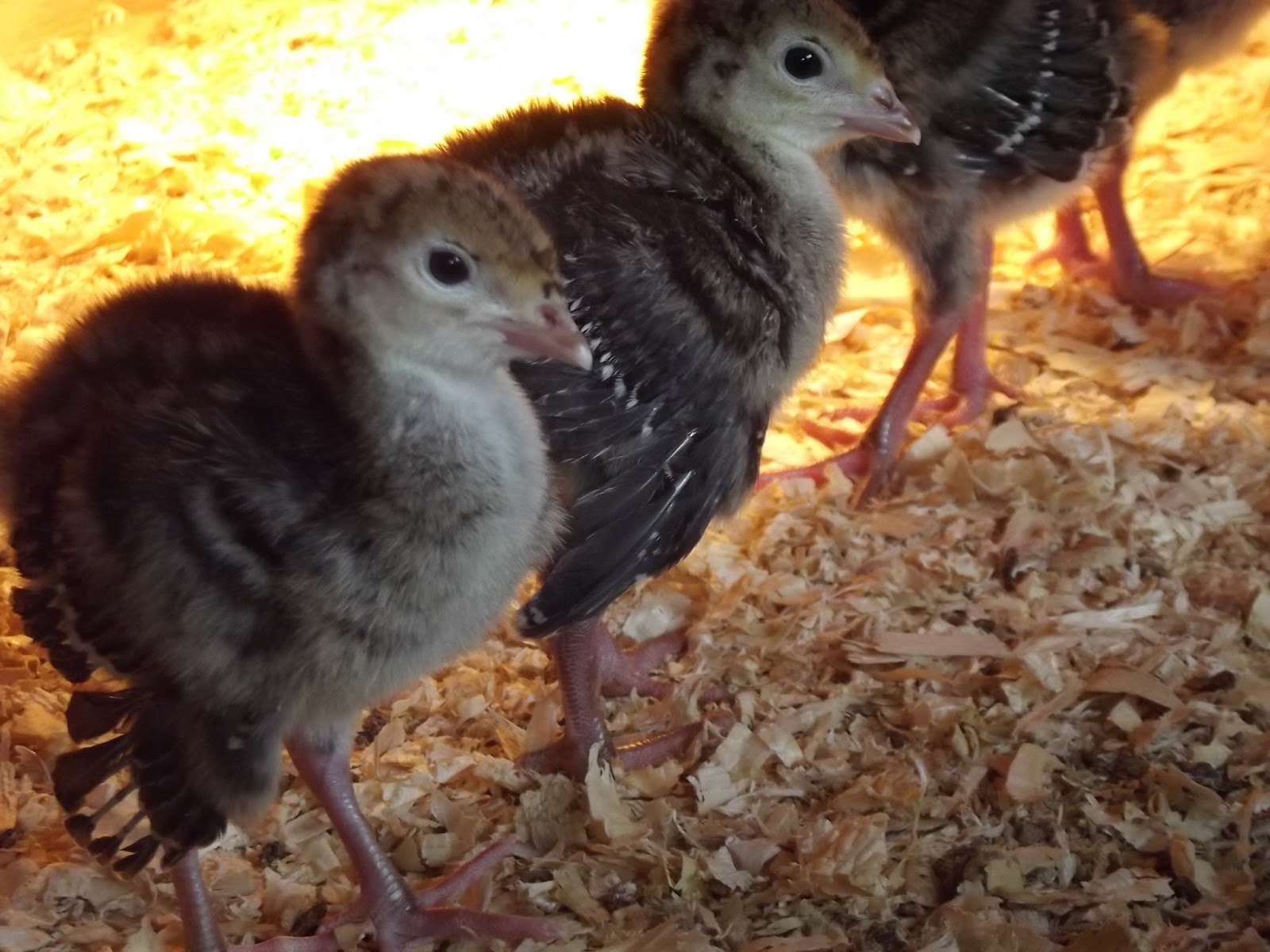
Two weeks ago, we also started 30 chicks (Cornish Cross meat birds) and five turkey poults. We are still happy with the Black Australorps and New Hampshire Red hens from our first flock last spring, as they are popping out eggs and free ranging just fine, but wanted some chickens to just feed out quickly, and get in the freezer. So far, the chicks are behaving as advertised, eating like crazy, and gaining size so fast, the feathers can't keep up to cover them. They are supposed to be eight or nine weeks to butchering weight and done. I'm weighing the feed and being careful to ration them, as they will eat themselves into leg problems from too rapid weight gain otherwise. Another week or so, and we'll get them out on pasture, and see how that goes. I've heard mixed reviews.

Here are the turkeys just a couple days after arrival. They feathered out quickly, and their proportions now look more like their adult form. The Cornish Cross still look like round butterballs.


We've had a very dry spring, so I worry for the other newcomers, our trees. We planted 50 Korean pines for enhancing our windbreak and for the pine nuts, and will be planting 50 oaks and 50 chestnuts quite soon.I may have to do some watering to get them established and through their first year.

That's enough new arrivals for now.