Tuesday, July 12, 2016

Our sixth season gardening

It's early July, and we are well in to the sixth season of gardening here on our little farm. We've learned a lot, gotten better at it, but still have a long way to go. While we are planting a large garden that provides nearly all our veggie needs, its productivity and long term health still need improving. Just a look at our neighbors smaller, but lush and very well done garden reminds us that we are still on a journey.

Things that we've noticed so far this year:

We've been putting composted cow manure in the rows for three years now, and each year it seems the soil tilth is better, and the plants are more vigorous. We get some weed seed along with the nutrients, but they are mostly broadleaf weeds that pull or hoe very easily as long as we get them young.

By far our best year yet for peas. Party of it is better soil tillage, better soil because of the manure, better plant spacing, and more careful watering, but I still wonder if there is some other unnoticed variable of spring weather patterns that the pleas  just like this year.

Our first year for Colorado potato beetles. They finally found us. We have about 120 linear feet ( 36m) of potatoes, and about half have shown infestation. We are hand picking every other day or so, and so far the damage is not too bad.

Our brassicas show little cabbage moth damage so far, but will keep monitoring, as we had them last year, and there is still a ways to go. We've been harvesting kale and collards leaves, but the broccoli, cabbage, and brussels sprouts still are at risk.

Much less vole and rabbit damage this year- all the upgrades to the fencing has paid off, and we did not try sweet potatoes this year after last year's vole carnage. Might try them again next year, but need to come up with a trick to keep the voles at bay.

Have been lousy at taking photos, but here is a shot of our yard- we stopped mowing when the birds foot trefoil came on. Since we have two beehives now, we want plenty of food for them.


Wednesday, May 25, 2016

The last of the hazel nuts ( at least for now)

This past week, our permaculture guru friend planted another 2800 hazelnuts on our farm. This is the last open area that can be planted with large scale methods, with layout conducive to mechanized harvest. Any other trees we plant from here on out will be small numbers, and done by hand.

The hazelnuts that were planted in 2012 were challenged by drought conditions that year, but many survived, though some died back and are slowly recovering.

Here is one of the 2012 hazels

And here are some of the 2014 hazels (around 2500 all told). They had a well timed rain after planting, and are doing well. I don't mulch or use herbicides, but do mow next to the trees the first two years. These trees get little coddling, but the overall input costs are low as well.
And here are a couple of the brand new 2016 hazels, planted about two weeks ago.


All of these hazels were planted with a tree planter kind of like this one:  http://kelcomaine.com/tp300.cfm  pulled behind a tractor .

Unfortunately, we had a late hard frost that hit just as the nut trees were at their most sensitive. It also knocked all the sumacs back  on their heels. Here is one of our chestnuts, not sure if they will recover. Interestingly, the hazels had leafed out earlier, and were past the critical stage, and were not affected.

Even many of the large established hickories and oaks in our woods were hit hard. We'll see if these small ones have enough reserves left to recover, otherwise we'll be doing a lot of replanting.

Bonus photo- Our feral chives patch in bloom, that was already thriving when we moved here. Comes back strong every year.


Tuesday, May 3, 2016

new arrivals on the farm

We just got our bees this past weekend. Two hives worth, placed in top bar hives with the help of a beekeeping neighbor. Plexiglass observation ports are behind those hatches on the side.


I had read books, visited websites, talked to a few people who had kept bees in the past, but when it came to opening the packages, and dumping in the bees, it was awfully nice to watch it done in person. It seems like there is always some little detail that I hadn't thought to pin down, and also, everybody has an opinion on how to do things. It turns out that is especially the case with keeping bees.  

These bees were bought from a local business, which emphasizes natural  beekeeping. There are no frames or wires or other impositions on the bee's comb making, simply the wood bars across the top, so it will be interesting to see what they turn out. We'll worry about honey later, maybe not try to get any till next year, depending on how well the hives fare.

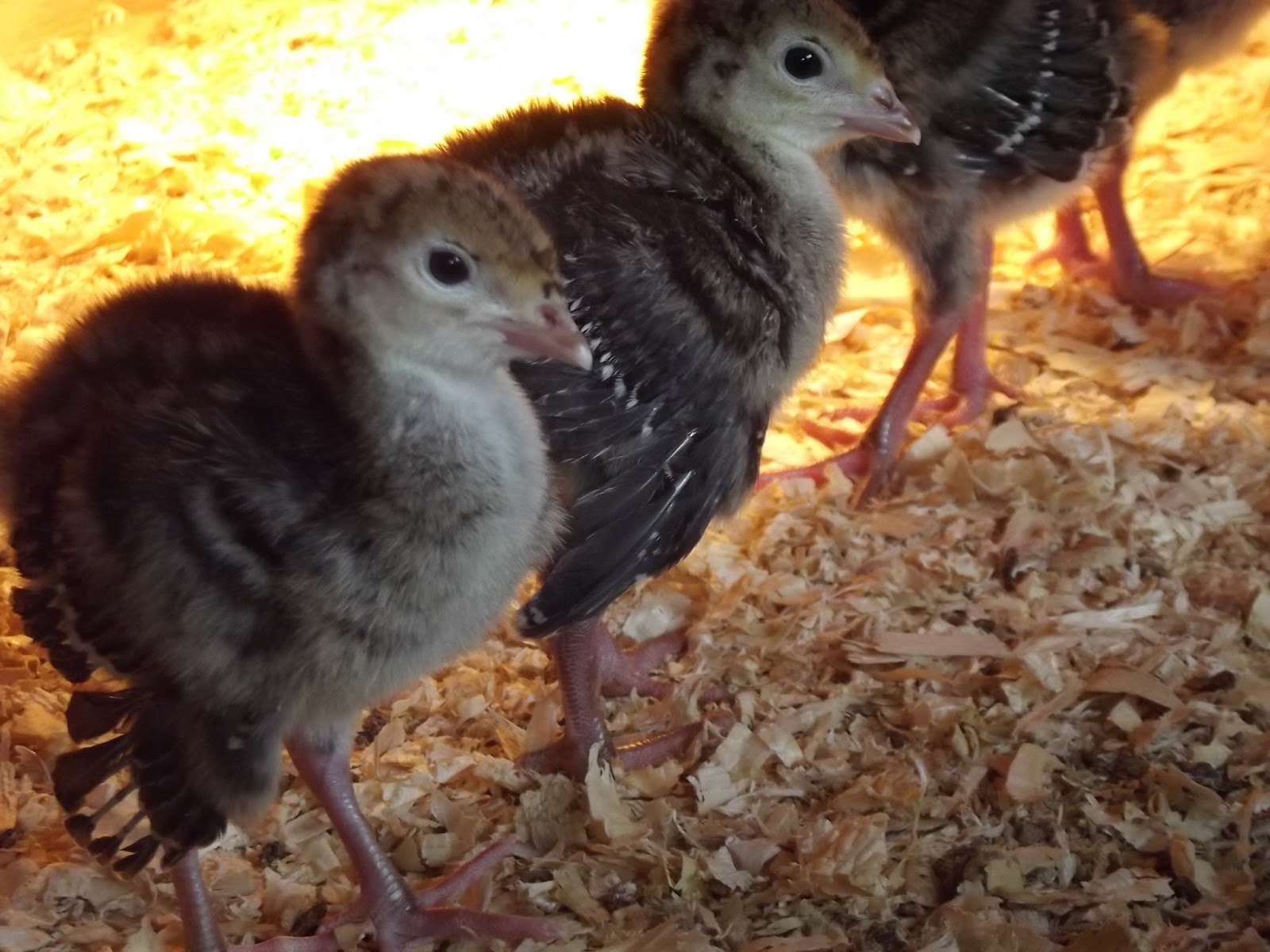
Two weeks ago, we also started 30 chicks (Cornish Cross meat birds) and five turkey poults. We are still happy with the Black Australorps and New Hampshire Red hens from our first flock last spring, as they are popping out eggs and free ranging just fine, but wanted some chickens to just feed out quickly, and get in the freezer. So far, the chicks are behaving as advertised, eating like crazy, and gaining size so fast, the feathers can't keep up to cover them. They are supposed to be eight or nine weeks to butchering weight and done. I'm weighing the feed and being careful to ration them, as they will eat themselves into leg problems from too rapid weight gain otherwise. Another week or so, and we'll get them out on pasture, and see how that goes. I've heard mixed reviews.

Here are the turkeys just a couple days after arrival. They feathered out quickly, and their proportions now look more like their adult form. The Cornish Cross still look like round butterballs.


We've had a very dry spring, so I worry for the other newcomers, our trees. We planted 50 Korean pines for enhancing our windbreak and for the pine nuts, and will be planting 50 oaks and 50 chestnuts quite soon.I may have to do some watering to get them established and through their first year.

That's enough new arrivals for now.


Monday, April 25, 2016

carrying capacity

I have known about the concept of carrying capacity for a long time, but have been thinking about it more lately, as world news brings more and more evidence of humans bumping up against our planet's physical limits. It also is in the back of my mind as I consider what this 40 acres ( 16 hectares) might ( or should) look like in 20 years.

Carrying capacity is another of those fractal things, where it can be viewed from the planetary level, right on down to plant spacing in a garden row. 

Carrying capacity is also complex in that it's not just the human centric view of how many humans can be supported ( though that's usually what is implied) , but should really focus on long term overall health of the entire biota. And local ecosystems are not static either, evolving and going through cycles on different and sometimes random durations.

In looking at our farm, and food production in general, it can be tricky to draw an appropriate system boundary and fully account all the inputs and outputs crossing that boundary. Thought needs to be given on what a reasonable area is for calculating carrying capacity.

A watershed? A region? A homestead? I happen to live in the Kickapoo River drainage basin, or watershed. No question at all that I still import large amounts of fossil fuel enabled external inputs in our little farm, but I hope year by year to reduce that.


The reality is, humans have been transporting resources and materials across distances for millennia, though of course for the last  century give or take, we are a couple orders of magnitude beyond what can be done with muscle power or water or wind. 
It is pretty obvious that carrying capacity of a specific area is lower if no material movements or cross subsidies are done, and some balance will be struck at a much lower rate of production as we end the fossil fuel era. 

And human activity can affect the "base" carrying capacity absent external inputs as well. Trees can be cut down, soil eroded, square miles paved over in urban areas, with regrowth or healing taking from decades to centuries. In the other direction, trees can be planted, water retention structures built, or complex and resilient plant communities can be nurtured. 

Overall the planetary carrying capacity has been degraded by human actions quite a bit. A couple years ago, I posted about humans as a keystone species that lost our way. The rogue keystone species

I guess I'm still dwelling on it, and still hoping we can renew our role as a positive contributor and an intelligent collaborator with our fellow organisms.

Humans are ( hopefully, maybe?) a special case, in that we are able to anticipate, or imagine possible futures, and then steering our actions in the present to make them so. Human scale agriculture, permaculture, animal husbandry, and similar technologies give us the chance to increase our species' individual carrying capacity, but with wisdom, we could be improving the carrying capacity of a region for all its inhabitants.


Tuesday, April 5, 2016

unplannned obsolescence

Og and Trog were creeping up on the megatherium, and each slowly nocked an arrow to prepare their attack. Only two men attacking a huge ground sloth was borderline doable, but they couldn't pass this up. As they drew back and began aiming, Og's bowstring went "twang!" and broke. 

"Well crap" he said. "I didn't bring a spare, have you got one?"

Trog said, "Sure; here, string it up before this beast gets away."
Og took it and unrolled it, and began to string it, but then he looked at it for a bit, puzzled. He then took one of his arrows, and tried to see if the string would fit in the arrow nock, which it did not, it was too thick.

He looked at Trog, and hissed "What the hell is this?" 

Og had been staring intently at the megatherium, but turned and looked at Og, who was almost hopping foot to foot, so anxious was he that the tribe's next week of meals was slowly shambling away, and he had no functional weapon. 

Og whispered back " Do you mean you are still using the OLD strings? Bog has been making the new stronger ones for four moons now. I can't believe this!"

Trog was purpling around the temples now, and said "Nobody told me about this crap, and you know I've missed the last three hunts with that leg the wooly rhino stepped on!" He sputtered "And besides, the old strings worked just fine."

"Well", Og said, "We don't dare try to take down this beast with only one weapon, I guess we are screwed."

Being paleo-Indians, they didn't talk much. This had been a remarkably extended conversation, brought on by extreme duress. They silently trudged back home, knowing that by the time they rearmed, the big lug would be long gone.

And so Og and Trog's tribe did not make it through the winter that year. Oh, there was still some game around, but it was getting more scarce every year, what with more and more mouths to feed, and another tribe taking up residence just two valleys over, and all the smaller game seemed to be quicker and more wary than the big lumbering ones they had relied on for many generations.

14,000 years later:

Steve remembered that he had tucked away the Home Power magazine collection on CD when they had moved, but had't looked at them for ages. When he had finally decided to move to a Mac instead of a PC, that had been one of the main reasons he made a point of purchasing the accessory external CD drive, since the Mac had no disc drive. He was thinking this might be the year to do solar thermal water heating, and wanted to go back and pull up the best articles for review. 

He fed the first CD into the drive. It hissed and clicked, the software finally launched, and the table of contents came up on the screen.

The first article he clicked on did not come up however. Instead, a message said that Apple no longer supported power PC. "But these are PDFs, why does that matter?" he thought.  Steve, not being a computer whizz, had no idea why the Mac was not backward compatible with what he thought was a universal format. 

He played around with different ways of trying to get at the files, but to no avail. How odd, the table of contents come up, but not the individual files. This was over his head. 

He then used bad language, a bad habit which showed no signs of going away.


Yes folks, all those terabytes of research, heartfelt blog droppings, cat videos, and political memes that our species cranks out continually will be as mist over a pond come the morning sun. Slowly fading and gone forever. Oh, some of it might still exist in some sense, but after twenty upgrades and four format revolutions, it will be as useless as a Clovis point would be to try to start your car with.


Wednesday, March 30, 2016

genetically modified organisms

OK, Here is my take on GMOs, so I'm getting into the opinion side of things, as opposed to farm updates. (The blog name "Virid views" can be taken two ways. It is both things I see along the journey, as well as my views on what I see.)

I oppose the use of genetically engineered organisms.

Before I list my concerns, this is where I am coming from. My opinion is partly science based, and partly value based. Regarding the science, I will give researchers the benefit of the doubt as I would with any other area of public concern, that they are conducting the best science they can, and that their initial assessments are the best information we have to go on. 

That  said, I do have a concern with the science. While they have not found any health risks to date, it seems like everyone thinks that if it doesn't cause cancer or obvious first order observable effects, it is ok. This in spite of the fact that many other technologies and medical "advances" have ended up causing problems we were not able to anticipate or observe initially. Human hubris seems to be hard wired into the race, not to speak of the powerful drive for profits.

Ok, my concerns:
1. The science on GMOs is preponderately about human health, but not nearly enough about introduction of unique organisms into the biosphere that have not been the result of millions of years of interactive evolution with the rest of the biome. Hubris once again, but in this case, making the assumption that we understand enough about how the ecosystem works that we are comfortable tweaking a variable that could never have happened through normal evolutionary pressure. When we consider the two relatively new areas of research such as epigenetics and the human gut biome, we need to realize that there is a LOT we still don't know when considering the impact of new biotechnology.

2. Industrial agriculture is also centrally controlled agriculture. At one time, a small holding farmer was the epitome of autonomy and self reliance, but ask today's large commodity farmer about their livelihood, and many will say that they feel trapped and don't like how things are trending, but see no way out. They work their butts off like any permaculturist or organic farmer, but in many seasons are just a step ahead of the bank in paying off yearly production loans.  Seed saving is becoming illegal, options for seed become less every year, and profit making is a central motive for much of agriculture research. This is one more area of the economy that has been allowed to become an oligopoly. 
https://msu.edu/~howardp/seedindustry.html

The endless treadmill- We already see reports of herbicide resistant weeds, pesticide resistant bugs, and ag tech companies coming up with "stacked" genes, enabling them to kill weeds by drenching them with TWO herbicides that the food crop has been modified to resist. Where does this end?  

4. Competition through collaboration- Long term agriculture practice, to be truly sustainable, needs to work with nature, rather than against it. That does not mean that we return to hunter gatherers, or use no technology, but rather be smart about choosing methods, and have a bias towards initially observing rather than dominating. GMOs are an attempt to dominate and create monocultures suitable only for mans needs, not the overall ecosystem health. If nothing else, enlightened self interest would have us collaborate with, and share a bit bit more with our fellow organisms, rather than risk some tipping point we aren't yet aware of. It's time to move from r- selected behavior to K- selected behavior, and become the keystone species we were meant to be.

5. No turning back, or invoking the precautionary principle- GMOs are a unique technology in that once released in to the world, we can't stuff it back in Pandora's box. Natural powers of replication will take over, and a new stable state of the ecosystem might not be one we like. Just look at the disasters we have already caused by transporting organisms all over the globe (intentionally and unintentionally) into new biomes they were not a part of, and wreaking havoc. GE organisms would potentially result in even worse unbalancing events.

6. Resilience and brittle technology- The more we depend on fewer and fewer food crop genetics, the more at risk we are for a black swan event or single point failure that we have no back up plan for. There is a reason that nature expresses such a wild abundance of genetic variation- IT WORKS. It has stood the test of time, and overall biome health results because the whole is greater than the sum of the parts. GMOs help make the food foundations of our society more narrow and unstable.

Some personal history- I was raised on a farm.  Back in 1970, Southern Corn leaf blight decimated the U.S. corn crop. 
https://en.wikipedia.org/wiki/Southern_corn_leaf_blight#Importance

We had our losses, but not as bad as some. What had happened, was a natural genetic variation that eliminated expensive hand detasseling seed corn fields had been incorporated into nearly all seed corn in the U.S. It turned out that this variation was also especially susceptible to the blight. One dampish year, and disaster struck. By my sophomore year in high school, us rural kids all had summer jobs detasseling again. Seed companies all doing the same thing to save money was brittle or "unresilient" technology in action.


Unfortunately, we have already opened the pandora's box, and we are unlikely to turn back, and in some cases, where GE organisms have already "escaped" or cross bred, we can't turn back. 

In the mean time, some of us plant many varieties of heirloom veggies, slowly figure out how to get a good crop without chemicals, and try to regain resilience.


Wednesday, March 16, 2016

sunroom seed starting or why we bought this house

I mentioned in my 2016 garden update post that the sunroom seed starting last year didn't go that well, and I plan to change things a bit to improve that. Here is the sunroom I am using to start our garden seeds. Photo taken the other day on a sunny, late winter day, as sun angle is starting to increase.


As you can see, I didn't tidy up for the photo, lots of things to notice. Firewood stacks, potting soil bags, self watering containers with herbs that stay green all winter, the big windows that admit sun into the living room, and even a treadmill so my wife can get the blood moving in the dead of winter. We have a big sliding door in to the room, and on sunny winter days, we have even left the door open to let warmer air in to the house.

A bit of history on the sun room. When we started looking for a small farm in this area, we soon found that real estate websites were a good way to get a feel for price ranges and features we might be able to afford (without spending hours traveling). 

Originally, I had wanted to just buy open land, and build a house and everything else from scratch. Arranging everything on permaculture principles and our own ideas sounded great. The farm we saw on the internet and ended up buying had a house, but the house had enough positive feature that  I gave up on my dream of building my own house. Looking back, it was a very lucky turn of events, as house building while still working a full time job would have been a nightmare. 

The sunroom was one of the features that sold us on the house ( I have already talked about the attached root cellar). The sunroom runs the full length of the south face of the house, and captures solar heat quite well.  Large windows between the sunroom and the living space also admit lots of light during the winter. I might go in to more detail later on how and why I ended up rebuilding it, but that's another story.

Starting seeds in here- Because of how I designed the roof overhang, the room actually gets the least direct sunlight during summer, when you don't need it, and gets lots of light during winter and the "shoulder months". The problem is that during nights, temperatures can still get too cold for seedlings to germinate or thrive, so I have used heat mats in the past, but not enough. I will use them even more this time. They are powered through a thermostat, so only come on at night when needed.
Like this one:
http://www.johnnyseeds.com/p-7626-hydrofarm-seedling-heat-mat-20-x-48.aspx

A future project is to possibly install thermal blinds on the
 large outer windows to close at night,  and fill some barrels with water to soak up heat during the day and release it during the night. Till then, I will unfortunately be using a lot of watts.

As I finally post this, the onion seeds have all germinated, and are looking good. Brassicas will be next to start in about two weeks.

Our first planting in the soil will be peas and potatoes, but the soil isn't quite ready for them yet. Can't wait!