I haven't talked much about the composting toilet I have been using for the last three years. I am using the lovable loo setup as described in the excellent book "The Humanure Handbook". The book is an well researched and detailed why and how to book that should allay any fears about germs and the general eww factor. Anyone serious about homesteading sustainably, and trying to minimize water and purchased fertilizer use needs to get over it and switch to this system.
http://humanurehandbook.com/downloads/humanure_sanitation_paper.pdf
We only moved here permanently this past July, but I would use it every time we were up here on weekends before our move. It now fills up considerably faster, but is still out in the unheated garage, pending any break in negotiations with my wife.
So, it was -14 F last night, and still well below zero when I had to answer nature's call this morning. The toilet itself is fine, with a regular toilet seat like anyone might use, but the rest of the amenities are rather Spartan. There is no magazine rack, but be assured I would not have chosen any reading material this morning anyway. A new low for me. Got me to thinking about the millions of people in the past that had no heated bathrooms. Both the more recent past when outhouses were the norm, and further back when indigenous folk had not even that. ( What DID they do before Sears catalogues???) We are such wimps. Here is the "throne".
The key to this system is access to lots of sawdust or other fine cellulosic material to get the carbon nitrogen balance right, and of course to cover each deposit to alleviate odors and risk of flies. Since there are a lot of small Amish sawmills in the area, this was easy for me. For $5, I got enough hardwood sawdust that it should last me for two or three years, and I could probably have got it for free with a little searching.
This spring will be the third year of the three year rotation described in the book, so I'll be putting the first batch on the garden soon.
Other news: The last of our Butternut squash in the root cellar finally started showing signs a couple weeks ago that we needed to cook it up quick. Here is the last batch coming out of the oven. The potatoes are storing really well, but the garlic is starting to soften up a bit and show a few sprouts.
Saturday, February 21, 2015
Tuesday, February 10, 2015
Wood splitter's elbow
I've been thinking about a common term lately; Tennis elbow.
Lateral Epicondylitis is the medical term, and wikipedia says it was first "described" in 1873. I'm willing to bet that while it may have been first mentioned in some medical journal or other paper of record then, plenty of people had described it prior to that, and in pretty negative terms, if only to their friends.
In reading about all the types of repetitive motion and trauma that can cause it, I think the number of cases caused by tennis may be a minority, and propose that the name should be changed to one more general, or maybe to one of a more pragmatic endeavor than tennis.
Like, for example, splitting wood, which is how I got mine. For the record, this condition has been on my mind since late October, when I split wood for a good part of the day. In my case, there was stupidity and stubbornness in addition to repetitive motion.
I know I am still getting in to shape after many years in a desk job, and I am not as young as I was when I could get away with weekend warrior crap. But I also take it personal when a knotty hunk of wood does not yield to a couple sound blows, and so keep whaling at it till I win, with increasing force as required.
While we had not moved here till this summer, I did come up as often as possible, and again, cram as much work in to a weekend as possible. A couple years ago, I got the same pain from digging post holes. It took 5 or 6 months to fade, and this time looks to be easily as long.
For all you homesteaders and hobby farmers out there, or anyone prone to taking tools in hand and swinging them for long stretches, I suggest you don't tell anyone you've got tennis elbow, that just doesn't send the right message. I plan to call my affliction wood splitter's elbow.
Here is a shot of the wood storage I cobbled together from project leftovers. ( photo is prior to splitting some of the wood) As of this writing, it is empty. I have some more wood stored in another location under weather protection, but we are in mid February, and it looks like we will just squeak by this winter.
Next fall, I plan to start earlier, and pace myself, as wood splitter's elbow is no fun.
Lateral Epicondylitis is the medical term, and wikipedia says it was first "described" in 1873. I'm willing to bet that while it may have been first mentioned in some medical journal or other paper of record then, plenty of people had described it prior to that, and in pretty negative terms, if only to their friends.
In reading about all the types of repetitive motion and trauma that can cause it, I think the number of cases caused by tennis may be a minority, and propose that the name should be changed to one more general, or maybe to one of a more pragmatic endeavor than tennis.
Like, for example, splitting wood, which is how I got mine. For the record, this condition has been on my mind since late October, when I split wood for a good part of the day. In my case, there was stupidity and stubbornness in addition to repetitive motion.
I know I am still getting in to shape after many years in a desk job, and I am not as young as I was when I could get away with weekend warrior crap. But I also take it personal when a knotty hunk of wood does not yield to a couple sound blows, and so keep whaling at it till I win, with increasing force as required.
While we had not moved here till this summer, I did come up as often as possible, and again, cram as much work in to a weekend as possible. A couple years ago, I got the same pain from digging post holes. It took 5 or 6 months to fade, and this time looks to be easily as long.
For all you homesteaders and hobby farmers out there, or anyone prone to taking tools in hand and swinging them for long stretches, I suggest you don't tell anyone you've got tennis elbow, that just doesn't send the right message. I plan to call my affliction wood splitter's elbow.
Here is a shot of the wood storage I cobbled together from project leftovers. ( photo is prior to splitting some of the wood) As of this writing, it is empty. I have some more wood stored in another location under weather protection, but we are in mid February, and it looks like we will just squeak by this winter.
Next fall, I plan to start earlier, and pace myself, as wood splitter's elbow is no fun.
Wednesday, January 28, 2015
The clathrate gun goes off.
The last few months I have seen a lot of articles about the permafrost craters, the subsea methane hydrate release plumes, and the high methane concentrations in parts of the arctic atmosphere. So, have we reached a tipping point? Is this really the clathrate gun going off? Of course, being hyperactive apes with very short attention spans, it just doesn't register on us as an event, or the threat it is. Geologic events have a pace we just don't see in our three score and ten, and are more apt to be of note to Ents and bristlecone pines.
At this point, climate change is probably baked in, but the rate might still be subject to some ability to affect. Unfortunately, we are pretty much doing everything to affect it in a bad way. Apart from spewing combustion products, clearcutting the tropical rain forests pretty much seals the deal. Deforestation rates in the Amazon, after slowing for several years, have spiked higher, mostly due to shifts in Brazil politics. Everyone is trying to make money NOW. There goes roughly 20% of the worlds oxygen production.
I'm not going to dwell on it or get depressed. After all, can't do much, but I do plan to do what I can. I have been thinking lately that I will add a biochar retort to my project list, and when clearing prickly ash to transition to oaks and maples, use some of this brush to make biochar. And of course, years down the road, once the nut trees are needing trimming, pollarding, cutting out dead ones, they can run through the retort as well.
It would be great if worldwide biochar production ramped up like Albert Bates and others suggest. I don't see that happening, but I will give it a shot, and get some soil amendment to boot.
Monday, January 5, 2015
Reverse stratification and wood heat
Well, the cold snap right now has slowed down doing any work outside, and not until this spring will we have any livestock that needs daily tending. No cabin fever yet, but we've been doing a lot of reading.
Our house is actually rather large, with three bedrooms upstairs, and an open plan kitchen, dining, living room space on the first floor. A spiral stair connects the two floors.
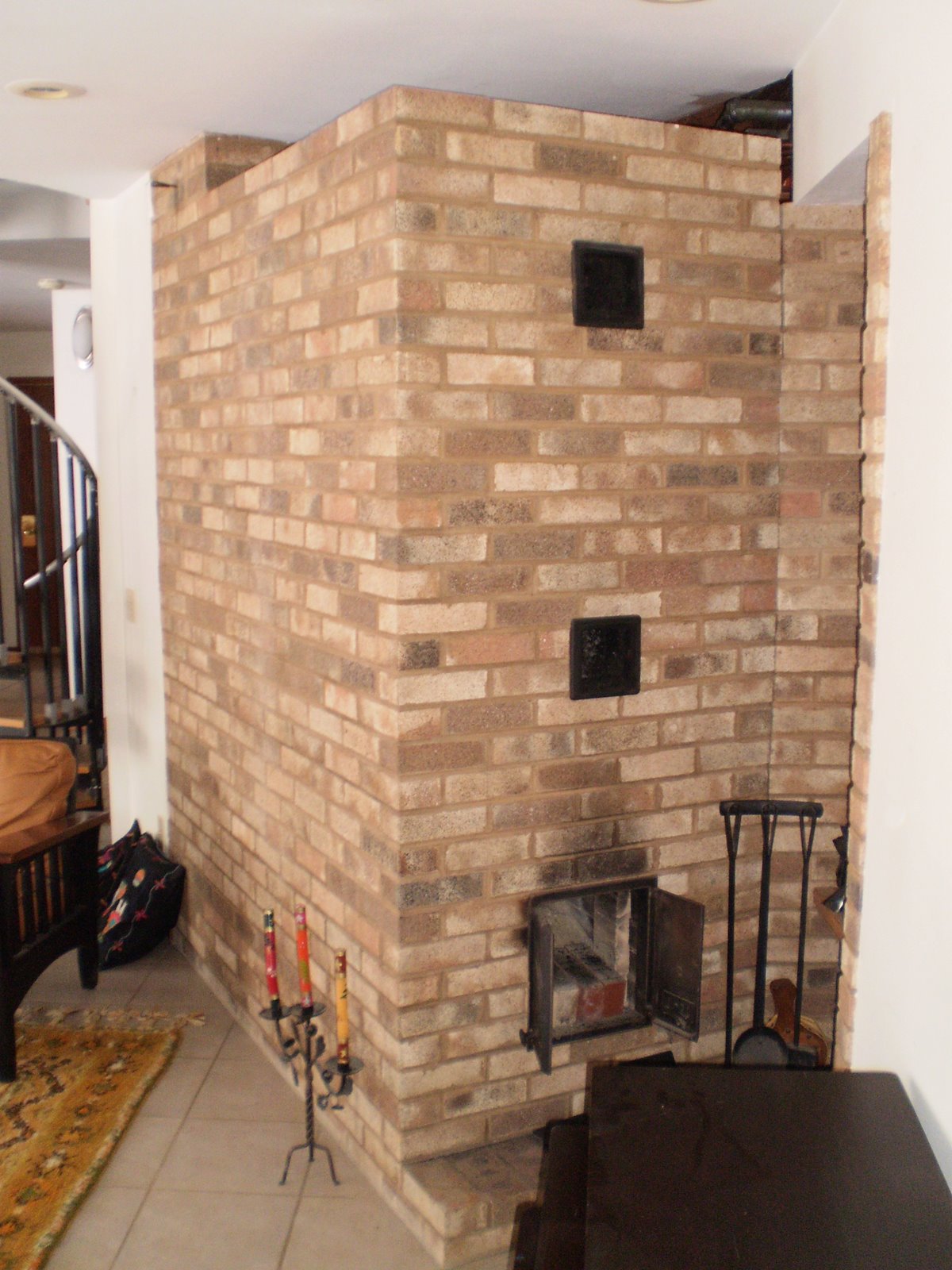
I'm really feeding the Russian wood stove ( also called furnace or oven) today, and noting how the house reacts to the cold. This is our first full winter actually living here, so learning a bit. Our Russian furnace captures a lot of the heat from the fire, and slowly releases it for many hours. So far, I've been keeping a fire going for 4-5 hours, then let it burn out in early evening, and shutting the damper. The bricks are still heating the house and nice to lean against the next morning, but this snap has the secondary heat source kicking on some. I fed the fire for six hours today.
We also have a small, high efficiency boiler feeding in floor heating in the concrete slab floor. So no forced air to move heat around. The thermostat on the in floor loops is set at 63F, and the wood heat has kept us just above that till now. Cool, but comfortable. So normally I'd expect the heat to rise and warm the upstairs, but that's not happening. Upstairs is now down to 53F. Now, we like a cool sleeping quarters, with a good comforter and a couple blankets, and we are fine, but that is getting pretty brisk if you aren't tucked in bed.
Air normally stratifies so that warmer air goes up, cool air goes down, and in the absence of fan circulation, stays that way. I'm just surprised that the stairway does not seem to let the two air masses switch places. Actually, this is a good thing, since I'd hate to heat the full upstairs when we spend the great majority of our time down stairs, and like the bedroom cool anyway.
The other variable affecting wood use and room temperature is the sunroom that extends the full length of the south side of the house. Even if below zero outside, if the sun is out, the sunroom warms up, and sun also extends into the house through the many large windows between the sunroom and the living space. This really helps warm the house. Well, the sun was not out that much today, so it definitely felt chillier than normal. One project on the list is to build thermal blinds for the sunroom windows that we could shut at night, but that item is low priority for now.
I posted a photo of our Russian furnace a long time ago, so here is a link. the Russian furnace
So, let's hope the firewood holds out till spring.
Our house is actually rather large, with three bedrooms upstairs, and an open plan kitchen, dining, living room space on the first floor. A spiral stair connects the two floors.
I'm really feeding the Russian wood stove ( also called furnace or oven) today, and noting how the house reacts to the cold. This is our first full winter actually living here, so learning a bit. Our Russian furnace captures a lot of the heat from the fire, and slowly releases it for many hours. So far, I've been keeping a fire going for 4-5 hours, then let it burn out in early evening, and shutting the damper. The bricks are still heating the house and nice to lean against the next morning, but this snap has the secondary heat source kicking on some. I fed the fire for six hours today.
We also have a small, high efficiency boiler feeding in floor heating in the concrete slab floor. So no forced air to move heat around. The thermostat on the in floor loops is set at 63F, and the wood heat has kept us just above that till now. Cool, but comfortable. So normally I'd expect the heat to rise and warm the upstairs, but that's not happening. Upstairs is now down to 53F. Now, we like a cool sleeping quarters, with a good comforter and a couple blankets, and we are fine, but that is getting pretty brisk if you aren't tucked in bed.
Air normally stratifies so that warmer air goes up, cool air goes down, and in the absence of fan circulation, stays that way. I'm just surprised that the stairway does not seem to let the two air masses switch places. Actually, this is a good thing, since I'd hate to heat the full upstairs when we spend the great majority of our time down stairs, and like the bedroom cool anyway.
The other variable affecting wood use and room temperature is the sunroom that extends the full length of the south side of the house. Even if below zero outside, if the sun is out, the sunroom warms up, and sun also extends into the house through the many large windows between the sunroom and the living space. This really helps warm the house. Well, the sun was not out that much today, so it definitely felt chillier than normal. One project on the list is to build thermal blinds for the sunroom windows that we could shut at night, but that item is low priority for now.
I posted a photo of our Russian furnace a long time ago, so here is a link. the Russian furnace
So, let's hope the firewood holds out till spring.
Wednesday, December 31, 2014
2014 review
End of the year and progress continues slowly on our farm. We put up a lot of food, traded for a lot more, and are in pretty good shape for the winter, but am already thinking about enhancing things as the seasons progress. Will hopefully get a prototype water collection system off the barn set up this year, with greater capacity once I get the basics worked out. Right now, I've got two IBCs and three rain barrels, so there is plenty more capacity that could be added.
Other major steps in the coming year are continued terracing of the hilly yard with conversion to garden strips and completion of the garden deer fencing and gates.
I will start closing in a chicken coop area in our pole barn in February, and getting ready for our first batch of chickens. I am trying to apply Harvey Ussery's principals, even though it is not a standalone structure. Have started the material list, and will begin buying stuff in January. (soon!)
We'll probably order our chicks in April. We plan to get some dual purpose breed, maybe black Australorps, something like that, and get straight run. The cockerels will end up in the freezer, some of the hens we'll keep for eggs.
Here is a shot of the electrical work coming along in the barn. I had decided to frame, insulate and drywall the workshop with electrical installation afterwards, running it all in EMT. I now have energized circuits in the workshop, and am starting the runs to the rest of the barn. Bending EMT or conduit requires a bit of math and geometry, so I'm taking it slowly, trying to avoid creating scrap.
I'm putting lots of outlets in the workshop. The lights are cheap fluorescents I already have from using to start seeds in the spring. I've simply got them hanging and plugged in, so I can lower or move to use for seed starting once more instead of buying all new lights. All have their own pull cord, so I can have on only as many as needed, saving electricity.
On other fronts, we made our first batch of cheese, a quick mozzarella using citric acid and rennet instead of a culture. It was just OK, but we will get better. Getculture.com is a great source for homesteaders who want to get supplies at small scale quantities. We found them very helpful for us first timers.
I am already signed up to take a wild food foraging class this spring, and in this coming year we hope to sign up for other classes being offered by the Driftless Folk School, which has just opened up a permanent campus very near us.
Right now, as the year ends, we are getting the seed catalogues from everyone, so it won't be long before we start garden plotting and rotation layout to get our seed orders roughed out.
Other major steps in the coming year are continued terracing of the hilly yard with conversion to garden strips and completion of the garden deer fencing and gates.
I will start closing in a chicken coop area in our pole barn in February, and getting ready for our first batch of chickens. I am trying to apply Harvey Ussery's principals, even though it is not a standalone structure. Have started the material list, and will begin buying stuff in January. (soon!)
We'll probably order our chicks in April. We plan to get some dual purpose breed, maybe black Australorps, something like that, and get straight run. The cockerels will end up in the freezer, some of the hens we'll keep for eggs.
Here is a shot of the electrical work coming along in the barn. I had decided to frame, insulate and drywall the workshop with electrical installation afterwards, running it all in EMT. I now have energized circuits in the workshop, and am starting the runs to the rest of the barn. Bending EMT or conduit requires a bit of math and geometry, so I'm taking it slowly, trying to avoid creating scrap.
I'm putting lots of outlets in the workshop. The lights are cheap fluorescents I already have from using to start seeds in the spring. I've simply got them hanging and plugged in, so I can lower or move to use for seed starting once more instead of buying all new lights. All have their own pull cord, so I can have on only as many as needed, saving electricity.
On other fronts, we made our first batch of cheese, a quick mozzarella using citric acid and rennet instead of a culture. It was just OK, but we will get better. Getculture.com is a great source for homesteaders who want to get supplies at small scale quantities. We found them very helpful for us first timers.
I am already signed up to take a wild food foraging class this spring, and in this coming year we hope to sign up for other classes being offered by the Driftless Folk School, which has just opened up a permanent campus very near us.
Right now, as the year ends, we are getting the seed catalogues from everyone, so it won't be long before we start garden plotting and rotation layout to get our seed orders roughed out.
Thursday, November 6, 2014
Touring the San Joaquin Valley by accident
Just recently got back from a long car trip to California to visit our son. Shot our carbon footprint stats all to hell, but that is another discussion. We car camped, stayed with friends, and did a combination of knocking of the miles on interstates, and getting on to state roads to get closer to the real America. Yeah, I know, happy motoring a la Kunstler, but we want to stay connected to our son as best we can across the miles. Not sure how long people will be able to do this, but for now, we can.
Saw some of the typical amazing scenery that can't be captured in snapshots, saw endless miles of uninhabitable dry terrain, and saw much of the industrial but unsustainable ag that feeds us all.
Coming through the Tehachapi pass, we of course saw all the various wind turbines, from the latest large designs, to some of the original clunky tax shelters. Due to a very old road atlas, and refusal to use GPS, we ended up coming out of the hills on a state road that we had no idea where it would lead. We never did find the campground we were hunting. So what ended up happening was we came through the town of Arvin, down at the southern end of the San Joaquin Valley, America's salad bowl and supplier of year round fruits and veggies.
We have all been hearing for months now about the severe, once in a century ( or epoch?) drought hitting California, so it was a bit surprising to see what appeared to be business as usual. Mile after mile of fruit trees, nut trees, grape vines, vegetable fields, all irrigated. There were even CAFO dairy operations sprinkled in to the mix, with semi loads of big bale hay trucked in and stacked ~20' high. Not sure were the manure was going or how it was handled. I have to say, it was all impressive and looked well run and organized.
The town of Arvin is ~90% Hispanic, ~30% under the poverty line, and is of course where those who farm the land live. Leaving town, we saw the occasional walled compound out in the fields, no doubt the original farmhouses of the actual landowners.
As we sped north, we began to see less irrigation, more and more dry, fallow, and unfarmed land. As the land would look without all the water from Colorado and the Sierras. This is what it will all look like when irrigation is no longer viable. Not sure if these fields were out of production because of the current drought, or if this was just too far to run the irrigation canals, but it was not a place I'd want to live. It was a good reminder of how fragile the current industrial ag system is, and how little it would take for much of the country to be cut off from much of its food supply.
On the way back, we saw long stretches in Nebraska in more traditional corn, but irrigated. I don't know if it was Ogalalla water, but based on the location, it probably was. That is ending soon as well.
Plant your gardens, eat seasonally, put up preserves, get busy relearning the way we ate before California fed us all.
Here is just one shot of the desolation, as we were leaving the San Joaquin Valley, and heading toward the hills and the Coast.
Saw some of the typical amazing scenery that can't be captured in snapshots, saw endless miles of uninhabitable dry terrain, and saw much of the industrial but unsustainable ag that feeds us all.
Coming through the Tehachapi pass, we of course saw all the various wind turbines, from the latest large designs, to some of the original clunky tax shelters. Due to a very old road atlas, and refusal to use GPS, we ended up coming out of the hills on a state road that we had no idea where it would lead. We never did find the campground we were hunting. So what ended up happening was we came through the town of Arvin, down at the southern end of the San Joaquin Valley, America's salad bowl and supplier of year round fruits and veggies.
We have all been hearing for months now about the severe, once in a century ( or epoch?) drought hitting California, so it was a bit surprising to see what appeared to be business as usual. Mile after mile of fruit trees, nut trees, grape vines, vegetable fields, all irrigated. There were even CAFO dairy operations sprinkled in to the mix, with semi loads of big bale hay trucked in and stacked ~20' high. Not sure were the manure was going or how it was handled. I have to say, it was all impressive and looked well run and organized.
The town of Arvin is ~90% Hispanic, ~30% under the poverty line, and is of course where those who farm the land live. Leaving town, we saw the occasional walled compound out in the fields, no doubt the original farmhouses of the actual landowners.
As we sped north, we began to see less irrigation, more and more dry, fallow, and unfarmed land. As the land would look without all the water from Colorado and the Sierras. This is what it will all look like when irrigation is no longer viable. Not sure if these fields were out of production because of the current drought, or if this was just too far to run the irrigation canals, but it was not a place I'd want to live. It was a good reminder of how fragile the current industrial ag system is, and how little it would take for much of the country to be cut off from much of its food supply.
On the way back, we saw long stretches in Nebraska in more traditional corn, but irrigated. I don't know if it was Ogalalla water, but based on the location, it probably was. That is ending soon as well.
Plant your gardens, eat seasonally, put up preserves, get busy relearning the way we ate before California fed us all.
Here is just one shot of the desolation, as we were leaving the San Joaquin Valley, and heading toward the hills and the Coast.
Friday, September 12, 2014
The rogue keystone species
Permaculture's third principle as identified by David Holmgren is "Obtain a yield". Makes sense; of course you need to get some net positive return for efforts, or you as an individual won't last long, and extending to a group or species, you will go extinct. There is a lot packed in to that principle though.
How do you decide how much of the annual bounty of growth is yield? If one is striving for a sustainable, long term system, how can you tell whether you are raking off too much yield, and degrading the future? The direct input output of our garden, for example, would typically account for the human hours expended, some dollars spent on seed, gas for the tiller, electricity for the well pump, and maybe even some accounting of depreciation for the aging of the tiller. But what about the state of the groundwater table, the nutrient levels in the soul, the disturbance of the soil microbial community, the tilth, organic content, the area biodiversity, even the oil wells in the middle east that the gasoline came from? One could go on and on a long time, noting the admittedly small, but non zero impacts of our tomatoes and sweet corn on the wider world. And much of it does not come down to dollars and labor hours. Nature does a different sort of accounting than man, and cares not about dollars or quarterly earnings.
Ecosystems are very complex, and for that matter, not static, but changing all the time, mostly on a time scale hard for us to see. One pattern that ecologists have identified is that in natural systems, there are often some niches that have less redundancy that others, or provide a critical service, such that the behavior of a single species has outsized impact on the overall ecosystem. These are called keystone species, because they kind of make the system work, similar to a keystone in an arch making the arch structurally sound. The Wikipedia entry does not mention humans as a keystone species, but to my mind we are, and have been altering the landscape to our and other species mutual benefit for a lot longer than recorded history.
Unfortunately, we went rogue a few hundred years ago, learning to take much more than a sustainable share of the annual solar driven yield, so we have been destabilizing the ecosystems all around the world. This trend only got worse after we started using stored fossil carbon energy to really overshoot the planet's capacity. The only humans who are in balance with their surroundings these days are extremely few, and are derided as primitive.
Can we, like the prodigal son, come back home? Whether mother earth "forgives" us or not, can we gain enough wisdom and regain our integrated relationship and stop the dissipating, adversarial relationship to our ecosystem? Since the 70's, ( and even before, really) some have seen and spoken out about the wrong path we are on, and now, in the 21st century, there seems to be a renewed call for change, so there is no longer an excuse of ignorance. Really, the obvious signs of degradation are hard to deny at this point. Simply because of the end of the fossil fuel era, we are in the early stages of overshoot returning to baseline, but it could be so much less traumatic if we quickly and willingly transition to collaborative ways to work in natural systems to meet our needs. We are beginning the return to a low energy life one way or the other.
My wife and I are slowly learning how to create a stable, sustainable homestead, and learn skills that we all will need in the generations to come. Permaculture is a mental template or set of guidelines for doing so.
In the mean time, about obtaining a yield, here are a couple photos from our garden harvest this year. Yes, I know that these annuals, in a garden that I rototilled and watered all summer, so are a few steps removed from a permaculture ideal. But we also added over 1000 hazels to the main field this year, so we are making progress.
Here are the potatoes in the bin I just built, still using cedar scraps from the sunroom rebuild two years ago. These were from seed potatoes we saved from last year's harvest, and they did quite well.
And here is the last of the collards. We will be eating a lot of collards this winter. They are great in soups. Patsy is dehydrating some, blanching and freezing some.
How do you decide how much of the annual bounty of growth is yield? If one is striving for a sustainable, long term system, how can you tell whether you are raking off too much yield, and degrading the future? The direct input output of our garden, for example, would typically account for the human hours expended, some dollars spent on seed, gas for the tiller, electricity for the well pump, and maybe even some accounting of depreciation for the aging of the tiller. But what about the state of the groundwater table, the nutrient levels in the soul, the disturbance of the soil microbial community, the tilth, organic content, the area biodiversity, even the oil wells in the middle east that the gasoline came from? One could go on and on a long time, noting the admittedly small, but non zero impacts of our tomatoes and sweet corn on the wider world. And much of it does not come down to dollars and labor hours. Nature does a different sort of accounting than man, and cares not about dollars or quarterly earnings.
Ecosystems are very complex, and for that matter, not static, but changing all the time, mostly on a time scale hard for us to see. One pattern that ecologists have identified is that in natural systems, there are often some niches that have less redundancy that others, or provide a critical service, such that the behavior of a single species has outsized impact on the overall ecosystem. These are called keystone species, because they kind of make the system work, similar to a keystone in an arch making the arch structurally sound. The Wikipedia entry does not mention humans as a keystone species, but to my mind we are, and have been altering the landscape to our and other species mutual benefit for a lot longer than recorded history.
Unfortunately, we went rogue a few hundred years ago, learning to take much more than a sustainable share of the annual solar driven yield, so we have been destabilizing the ecosystems all around the world. This trend only got worse after we started using stored fossil carbon energy to really overshoot the planet's capacity. The only humans who are in balance with their surroundings these days are extremely few, and are derided as primitive.
Can we, like the prodigal son, come back home? Whether mother earth "forgives" us or not, can we gain enough wisdom and regain our integrated relationship and stop the dissipating, adversarial relationship to our ecosystem? Since the 70's, ( and even before, really) some have seen and spoken out about the wrong path we are on, and now, in the 21st century, there seems to be a renewed call for change, so there is no longer an excuse of ignorance. Really, the obvious signs of degradation are hard to deny at this point. Simply because of the end of the fossil fuel era, we are in the early stages of overshoot returning to baseline, but it could be so much less traumatic if we quickly and willingly transition to collaborative ways to work in natural systems to meet our needs. We are beginning the return to a low energy life one way or the other.
My wife and I are slowly learning how to create a stable, sustainable homestead, and learn skills that we all will need in the generations to come. Permaculture is a mental template or set of guidelines for doing so.
In the mean time, about obtaining a yield, here are a couple photos from our garden harvest this year. Yes, I know that these annuals, in a garden that I rototilled and watered all summer, so are a few steps removed from a permaculture ideal. But we also added over 1000 hazels to the main field this year, so we are making progress.
Here are the potatoes in the bin I just built, still using cedar scraps from the sunroom rebuild two years ago. These were from seed potatoes we saved from last year's harvest, and they did quite well.
And here is the last of the collards. We will be eating a lot of collards this winter. They are great in soups. Patsy is dehydrating some, blanching and freezing some.
Subscribe to:
Posts (Atom)